Active DSN activity
—Loading current region summary…
| Loading active DSN activity… | |||
Active NSN activity
—| Mission | Details | Status | Network |
|---|---|---|---|
| Open this tab to load current NSN activity. | |||
Recent contacts
Contacts seen in the last 60 minutes.
| Mission | Last seen | Contact | Network |
|---|
Spacecraft catalogue
| Loading spacecraft catalogue… | |||
Images use the spacecraft filenames from the JSON and can be clicked to open a larger preview.
☀️ Space Weather ↗
Checking…
R—S—G—
🚀 UPCOMING - next 30 days
Loading…
Launches and asteroid approaches
Loading upcoming events…
Launch data refresh pending
Sources
Public data feeds, official references and SpaceOpsLab processing notes.
NASA/JPL DSN Now XMLActive Deep Space Network observations. SpaceOpsLab checks this feed every 5 minutes.
NASA SCaN Now — NSNPublic Near Space Network direct-to-Earth and space-relay activity. SpaceOpsLab displays cached live snapshots from a separate NSN worker.
NOAA SWPCSpace weather summary and alert context. SpaceOpsLab refreshes this source about every 15 minutes.
JPL Small-Body DatabaseNear-Earth object close-approach data used for asteroid-watch events. Refreshed about every 15 minutes.
TheSpaceDevs Launch Library 2Launch schedule and mission context. SpaceOpsLab refreshes launch data about every 15 minutes.
Curated sky eventsReviewed astronomy and sky highlights maintained by SpaceOpsLab for monthly context. Discovery candidates are reviewed before publication.
NASA EyesNASA interactive apps, including DSN Now and other mission visualisations.
Deep Space Network
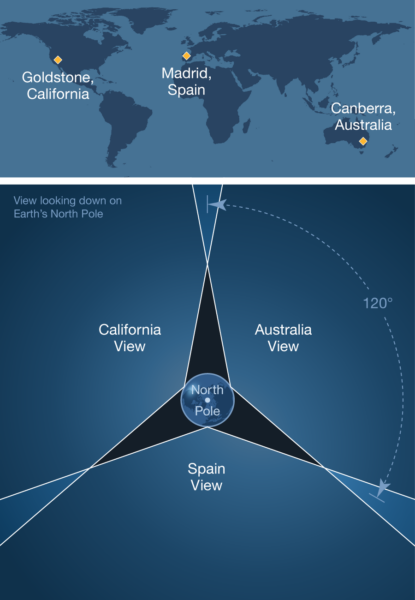
Three sites, near-global sky coverage
The DSN uses three main ground-station complexes spaced around Earth: Goldstone in California, Madrid in Spain, and Canberra in Australia. Their longitudes help keep deep-space spacecraft in view as Earth rotates.
🇺🇸 Goldstone
🇪🇸 Madrid
🇦🇺 Canberra
Platform note
SpaceOpsLab aggregates public-source space activity feeds through automated workers, stores historical snapshots in a database, and generates summaries, analytics and mission context for educational use. DSN views show observed Deep Space Network activity and do not imply NASA/JPL endorsement.